Climate change events are not always sudden and dramatic. They can play out quietly over time, slowly but surely eroding livelihoods in vulnerable regions. Such ‘slow’ events often sit outside the remit of disaster policy, meaning that affected communities are often left behind by the central government. For example, coastal flooding in Timbulsloko, Indonesia, has taken place over several years, with incremental but nonetheless devastating results. Policymakers must reform climate adaptation frameworks in response to this slower category of risk.
In Timbulsloko, a village in the north of Java, Indonesia, disaster does not arrive as a sudden shock. Instead, it arrives silently with the rising tide, slowly swallowing the land in a flood that never goes away.
This permanent flooding has sunk thousands of hectares of productive land, effectively erasing the backbone of the national economy. Even so, this massive destruction along Java’s northern coast often slips through the cracks of national disaster policy frameworks simply because it manifests as a slow-onset hazard rather than a single dramatic cataclysm.
Looking closely at Timbulsloko reveals how slow-onset disasters are quietly dismantling the livelihoods that sustain one of Indonesia’s busiest coastal corridors. Northern Java is flat, fertile, and well-connected by major roads. This makes it a busy hub for agriculture, fisheries, and industry, linking major economic centers. But this heavy land use has made the area more vulnerable to increasingly extreme climate conditions. As the land floods and sinks, productive land disappears.
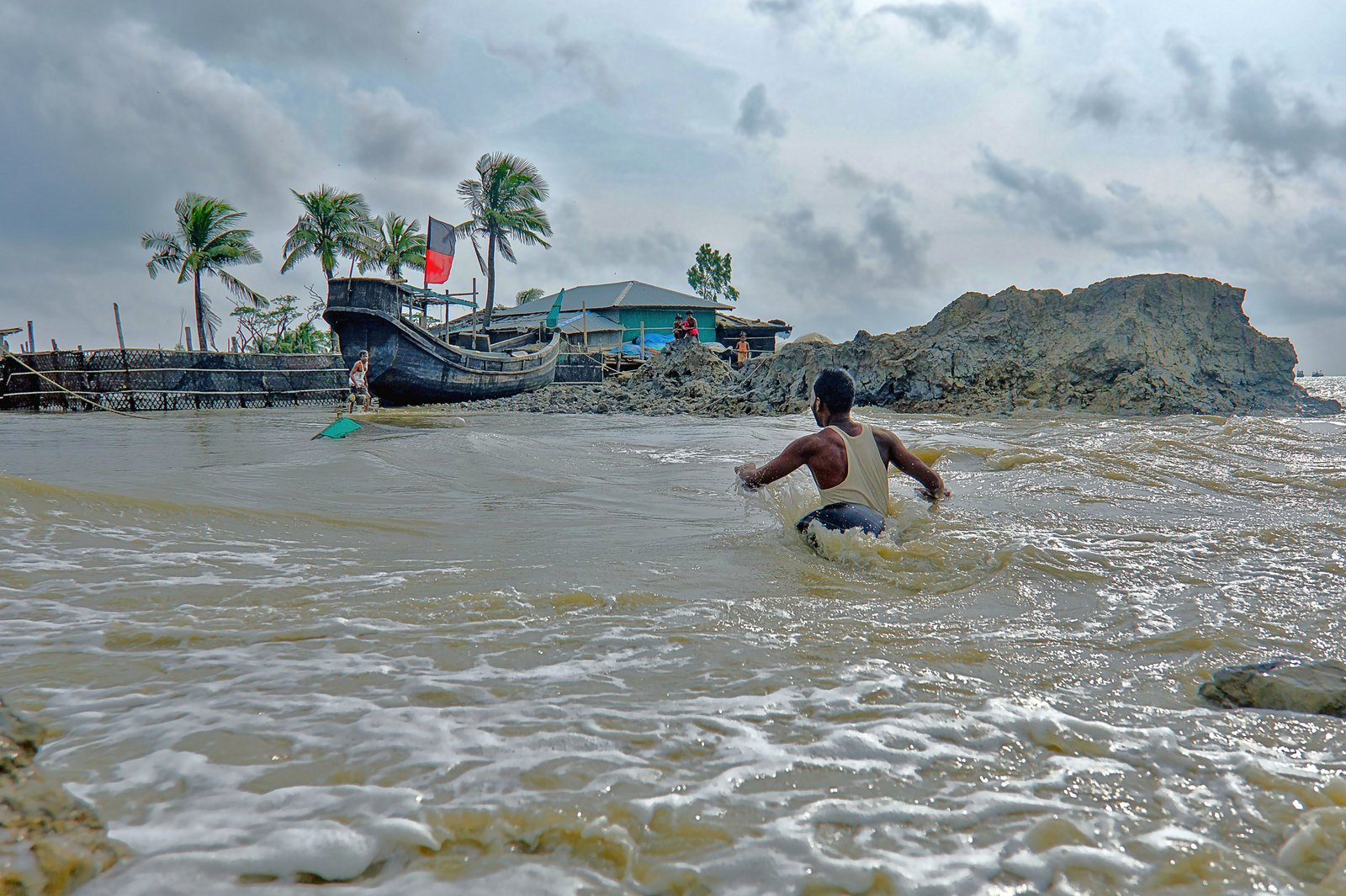
Over the past three decades, Java’s northern coast has faced increasingly frequent and intense tidal flooding. The impact has been severe enough to trigger temporary mass displacements. The flooding has not stopped. It continued to spread along the coast, reaching Timbulsloko around 2010. Slowly but surely, the coastline has degraded and vanished, until the boundary between land and ocean in Timbulsloko simply ceased to exist.
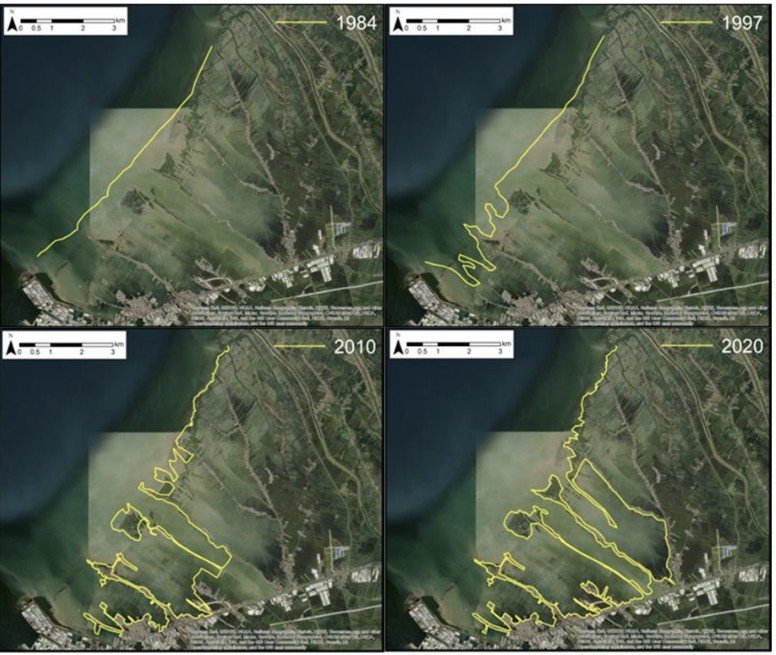
Tidal flooding and the transformation of coastal livelihoods
As the coastline vanished and the boundary between land and sea faded away, local livelihoods began to collapse. Rather than a sudden dramatic event, this was a slow process mirroring the gradual degradation of the coast.
Economic collapse occurred long before formal government help arrived. This is not due to a lack of local resilience. In fact, for years, the community engaged in an exhausting cycle of adaptation. When the waters first rose, residents elevated their land with soil. As flooding intensified, they built stilt houses, eventually shifting to floating structures. It was not enough to withstand the flooding.
A similar downward spiral devastated the local economy. Productive fishponds gradually lost their yields until they were completely submerged. Former aquaculture farmers were forced into coastal capture fishing, a desperate ‘lifeboat’ strategy, before ultimately resorting to precarious, informal jobs.
This situation points to the fundamental ‘limits to adaptation’ – where adaptive actions can no longer prevent intolerable risks to livelihoods. The people of Timbulsloko have been pushed beyond these geographical and economic breaking points. These drastic occupational shifts are not indicators of resilience: they are distress signals that indicate that the households’ adaptive capacity has been stretched to its absolute limit.
Tidal flooding: a paradox in national disaster management
The root of this governance crisis lies in a critical blind spot within Indonesia’s legal framework. Under Indonesia’s 2007 Law on Disaster Management, the definition of a disaster is overwhelmingly event-based. The system is designed to mobilize resources for rapid-onset, highly visible shocks. Because permanent tidal flooding develops slowly and cumulatively, it is legally invisible.
This lack of specific terminology acts as a bureaucratic wall. It blocks affected communities from accessing vital central government funds, emergency relief, and structural recovery schemes. When a slow-onset crisis is not legally classified as a disaster, it is downgraded to a routine environmental issue. Consequently, the economic collapse experienced by coastal households occurs entirely outside formal disaster recovery frameworks. The state’s policy structure creates a blind spot that allows slower-paced destruction to proceed unchallenged.
In the absence of state intervention, a coalition of non-state bodies has stepped in. Academics, non-governmental organizations, and private companies have converged on Timbulsloko, turning the village into a living laboratory for climate adaptation. From participatory research to community-based floating infrastructure, these external groups are attempting to hold back the tide.
However, this fragmented approach has fundamental limitations. Interventions rely heavily on the temporary institutional agendas and finite funding cycles of external groups. Without structural coordination or a clear policy mandate from the government, these efforts remain partial, localized experiments. They cannot scale up, nor can they provide long-term stability. A living laboratory is an excellent space for innovation, but it is not a substitute for comprehensive public policy.
Indonesia is not alone in facing this existential threat, and there are international precedents to follow. In the context of progressive slow-onset disasters, Bangladesh serves as a prime example of transitioning from reactive disaster management to proactive Disaster Risk Reduction (DRR). Bangladesh has successfully implemented strategies to tackle slow-onset hazards like rising soil salinity and sea-level rise.
To effectively address the crisis in Northern Java, Indonesia must reform its disaster management paradigms. The country needs a legally binding policy framework that explicitly recognizes slow-onset hazards as legitimate disasters integrated into DRR strategies. This shift in governance would unlock state resources for structured livelihood transitions, preventing communities from being trapped in an underfunded cycle of trial and error.
Recognizing the slow, silent erosion of coastal life is the first necessary step toward saving it. This perspective underscores the need to interpret extreme climate impacts not merely through the lens of rapid and disastrous events, but through the long-term processes that are collapsing the livelihood of coastal households.