Mainstream climate mobility frameworks often treat displacement as a future risk. But for many Indigenous communities around the world, environmental displacement long predates climate change as a named crisis. The experiences of the Batwa in Uganda, and the Ogiek in Kenya, show that ignoring these histories of dispossession leaves climate mobility policy and approaches ill-equipped to protect those most at risk.
Climate change is often framed as a driver of human mobility. From rising seas to prolonged droughts, global headlines warn that up to 1.2 billion people will be forced to move by the middle of this century, with East Africa alone projected to see up to 55 million people internally displaced under extreme climate scenarios.
However, this dominant narrative masks a deeper injustice: for many Indigenous and marginalized communities, climate- and environmental-related mobility is not a new phenomenon, nor is movement always possible. Instead, contemporary climate displacement is layered onto centuries of dispossession, exclusion, and enforced immobility.
Indigenous peoples worldwide face disproportionate exposure to climate impacts despite contributing least to global emissions. They make up roughly 6% of the global population, yet steward much of the world’s remaining biodiversity. Where they retain access to land and governance authority, environmental resilience tends to be stronger; where they do not, vulnerability deepens. This results from historical and ongoing systems that have stripped Indigenous communities of land and rights, while hampering their adaptive capacity.
Environmental displacement did not begin with climate change
Mainstream climate mobility frameworks often treat displacement as a future risk, an unfortunate consequence of warming, extreme weather, or sea-level rise. But for Indigenous peoples around the world, environmental displacement long predates climate change as a named crisis.
Forced removals for resource extraction, agricultural expansion, infrastructure, and conservation have repeatedly severed communities from their lands, livelihoods, and cultural systems. In East Africa alone, the Batwa of Uganda, Rwanda, and Burundi; the Ogiek, Endorois, Sengwer, Illchamus, and Yaaku of Kenya; and the Maasai of Tanzania, to name just a few, were dispossessed from their ancestral territories long before climate mobility entered the policy lexicon.
These histories shape who is exposed to climate risk today: communities pushed onto marginal lands—arid zones, floodplains, degraded forests—have fewer options to adapt, move safely, or stay put when droughts intensify and ecosystems collapse. The impact is clear: climate and environmental-related (im)mobilities are increasing in the region, and mobility patterns among pastoralists are changing.
Even so, dominant climate policy tends to isolate climate-related movement from these earlier forms of environmental displacement. Conservation-driven evictions, development projects, and extractive industries are treated as separate issues, despite being deeply entangled with the environmental changes that now drive climate mobility. Research on Uganda’s Batwa illuminates how historical eviction has produced enduring food, health, and livelihood vulnerabilities, now compounded by erratic rainfall and rising temperatures.
Conservation as displacement, adaptation as dispossession
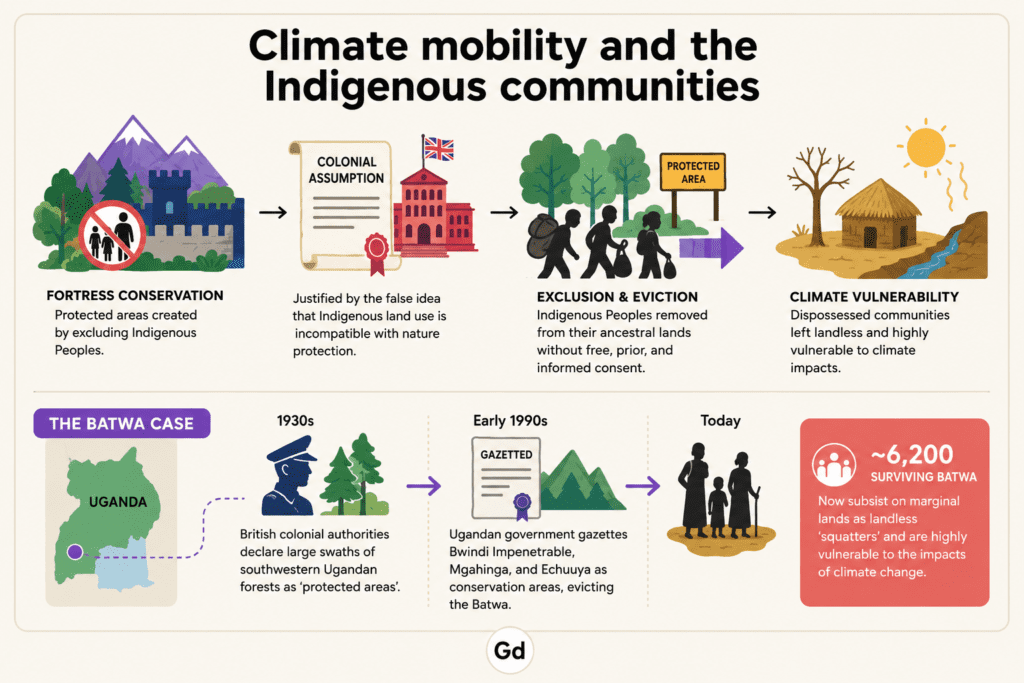
Nowhere is this clearer than in the global conservation model often described critically as “fortress conservation“. From East Africa to South Asia and Latin America, protected areas, national parks, and wildlife refuges have frequently been established through the exclusion or removal of Indigenous peoples, justified by colonial assumptions that Indigenous land use is incompatible with environmental protection.
Take the Batwa. Beginning in the 1930s, British colonial authorities declared large swaths of their southwestern Ugandan forests as ‘protected areas’. In the early 1990s, the Ugandan government completed the dispossession by gazetting Bwindi Impenetrable, Mgahinga, and Echuuya as conservation areas, evicting the Batwa without free, prior, and informed consent to protect mountain gorillas. The roughly 6,200 surviving Batwa now subsist on marginal lands as landless ‘squatters’ and are highly vulnerable to the impacts of climate change.
Mobility, immobility, and injustice
Climate policy also often assumes that movement is an easily available adaptation strategy. But mobility is unevenly distributed. Many Indigenous communities face involuntary or forced immobility: unable to move due to economic inequalities, discrimination, lack of legal recognition, or attachment to ancestral lands, even as living conditions become less viable. The Batwa today risk becoming what experts call a ‘trapped population’, exposed to climate harm, excluded from governance and without the resources or rights to safely relocate.
Others are compelled to move repeatedly, first through historical dispossession, then through development or conservation projects, and now through climate-related hazards. These layered displacements erode social cohesion, undermine livelihoods, and restrict future mobility options. Climate displacement is therefore not a single event, but part of a continuum of environmental injustice.
Despite the IPCC’s recognition that vulnerability is shaped by historical and structural factors, climate mobility governance rarely grapples with these continuities, treating past dispossessions as irrelevant to present policy, as though vulnerability resets with each new crisis.
Toward an environmentally just approach to climate mobility
A growing body of regional and global case law offers a starting point. Across Africa, the African Commission’s Endorois decision (2010) and the African Court’s Ogiek ruling (2017, with reparations ordered in 2022) both held that conservation-driven evictions of Indigenous communities violate rights protected under the African Charter on Human and Peoples’ Rights, though implementation in both cases remains slow and contested.
Regional and international policy commitments are likewise shifting, most of which identify participation as a core principle. At the AU level, the Kampala Convention (2009) on internally displaced persons and the AU Climate Change and Resilient Development Strategy 2022–2032 commit member states to inclusive, rights-based responses.
At the international level, UNFCCC Action for Climate Empowerment and the Local Communities and Indigenous Peoples Platform (LCIPP) embed Indigenous knowledge, education, and public participation in climate action.
However, none of these instruments has translated into operational protections for communities like the Batwa, who remain absent from Uganda’s national adaptation planning despite acute climate vulnerability, a common experience among Indigenous and minority communities around the world.
An environmentally just approach must therefore cut across the silos that currently separate sustainable development, disaster risk reduction, migration governance, climate adaptation, and resilience-building, replacing them with participatory, rights-based frameworks anchored in free, prior and informed consent, as well as a principled foundation of justice that recognizes how Indigenous communities became vulnerable— and why.
Concretely, that means:
- Recognizing Indigenous land and territorial rights as central to climate adaptation.
- Treating conservation, development, and climate action as potential drivers of displacement, not neutral solutions.
- Accounting for immobility as climate vulnerability rather than individual failure.
- Linking climate mobility governance to reparative justice for historical dispossession.
As climate impacts intensify, the question is not only how many people will be displaced, but whose displacement is deemed acceptable, whose (im)mobility is ignored, and whose histories are erased. Without confronting these injustices, climate mobility policy risks reproducing the very vulnerabilities it claims to address.
This blog piece is part of a special series launched in the context of the work that Global Development Network (GDN) is carrying out in close partnership with the Center for Systems Solutions, and Future Earth US global hub, in support of the Belmont Forum’s Collaborative Research Action (CRA) on Integrated Approaches to Human Migration/Mobility.