Aid budgets are under pressure, with many development programmes around the world constrained or even shelved entirely. In this context, funders must maximize the impact of every penny spent. A shared framework, based on identifying and supporting research with the greatest transformative potential, could provide funding bodies with a useful compass to navigate this challenging period.
Amid a sharp contraction in global aid budgets, research for development faces unprecedented pressure to ensure that scarce resources deliver lasting impact. Bilateral aid programmes are shrinking, multilateral funding is under strain, and research partnerships are being paused or restructured.
Decades of experience—from donor-driven models of knowledge and technology transfer, to recognition of the limits of national innovation systems in addressing sustainable development, to strengthening national research systems and forging more equitable partnerships—have sharpened the understanding of what it takes for research to drive lasting development outcomes. But progress remains fragmented, and persistent structural challenges continue to go unaddressed.
In this context, the central question for funders is how to allocate increasingly limited funding in ways that allow existing momentum to add up to more than the sum of its parts, strengthening the systems capable of delivering sustained and transformative change.
Why transformative research systems matter now
Institutional structures too often work against the conditions needed for research to drive lasting change. This can fragment effort, reproduce inequalities in who sets the agenda, and reinforce tensions that make it difficult for promising approaches to scale or connect across sectors and systems.
Institutional barriers to transformative R4D take many forms. Research agendas may be tightly controlled while investment in research capacity remains inadequate; universities reward productivity metrics over social impact; and systems heavily reliant on external funding can struggle to build local ownership.
Where research ecosystems are resilient, investments reinforce one another and change compounds over time. Initiatives such as the Science Granting Councils Initiative are strengthening research governance and strategic capability across participating countries, while African-led organizations such as the Science for Africa Foundation and the African Academy of Sciences are building new models of locally governed research funding, leadership and collaboration.
In an era of constraint, this raises an urgent question for funders: not only what to fund, but whether funding choices are actively strengthening the systemic conditions that allow transformative momentum to take hold and grow.
A compass for funding conversations
The Transformative Research for Development (TR4D) framework was developed to support precisely this kind of conversation.
Existing frameworks in the R4D space, like IDRC’s Research Quality Plus (RQ+) and CGIAR’s Quality of Research for Development (QoR4D), have made important contributions to how funders and evaluators assess the quality of individual research projects. Alongside these, a growing number of initiatives—including the Africa Charter for Transformative Research, UKCDR’s equitable partnerships guidance, and the work of Southern Voice—are focusing minds on more equitable and connected approaches to research funding and partnership.
However, both sets of contributions operate largely at the level of specific funding relationships and research processes. TR4D addresses a different and prior set of questions: how to identify the systemic conditions that should shape where funding goes in the first place—and crucially, how to recognize and build on the momentum that these and other existing initiatives have already created.
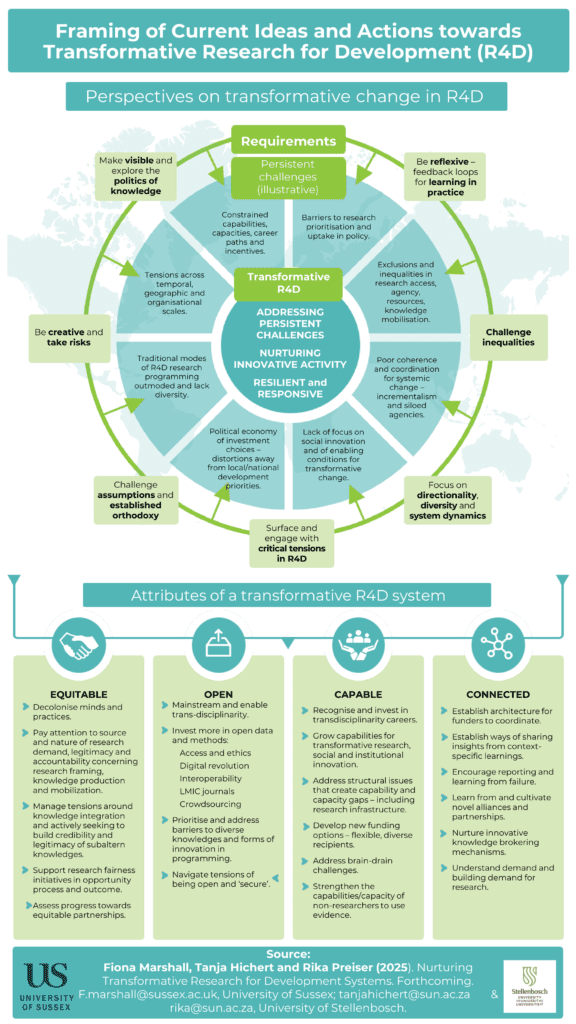
The framework draws on decades of collaborative learning across long-term research initiatives at SPRU, complemented by FCDO knowledge system initiatives, and took its current form through a participatory foresight initiative led by Stellenbosch University and funded by the International Development Research Centre (IDRC). It is designed to be used collaboratively, as a starting point for dialogue about which system properties matter most in a given context, where momentum already exists, and how it can be recognized and nurtured.
Four attributes emerged from the synthesis of grounded examples of change initiatives across diverse contexts:
- Equitable: Inclusive participation and attention to power in agenda setting, access, and benefit sharing.
- Open: Transparency, collaboration, and meaningful engagement with diverse knowledge systems
- Capable: Sustained investment in skills, institutions, and research infrastructure.
- Connected: Integration across actors, sectors, funding streams, and governance levels.
These points provide a diagnostic lens for understanding the properties that recur across efforts to strengthen research systems. Different contexts will foreground different attributes, and the framework actively invites that conversation.
In this sense, the TR4D framework functions as a compass rather than a blueprint. Rather than prescribing allocations or ranking priorities, it helps funders ask better questions about where their investments sit within the broader system, and where the real leverage lies.
Questions for funders in an era of constraint
The four attributes offer a practical entry point for funders thinking about where to direct scarce resources. Rather than starting from scratch with each new funding cycle, they provide a shared basis for asking:
- How are our investments contributing to and benefiting from the systemic conditions that enable research to drive change?
- Where are our mechanisms unintentionally reproducing the inequalities in how funding flows, who sets the agenda, and who benefits, that hold systems back?
- Which attributes are most underdeveloped in this context, and where would investment have the greatest systemic effect?
- Are we creating synergies across equity, openness, capability, and connectivity, or inadvertently working at cross purposes?
These questions matter most when funders ask them together, and with researchers, national stakeholders and communities who know these ecosystems best. A shared framework like TR4D creates the conditions for exactly that, enabling national and international funders to compare readings of the same ecosystem, identify where their investments complement or duplicate one another, and coordinate around the enabling conditions that none can build alone.
From scarcity to strategic leverage
The contraction of aid budgets presents serious risks for research communities, particularly in low- and middle-income countries where research systems are already under strain. It also creates a moment of reckoning—one that demands more honest reflection on whether current funding approaches are building the systemic conditions for lasting change, or simply sustaining activity.
Scarcity, in this sense, is also an opportunity. Not all investments have equal systemic effect. Modest support for institutional connectivity, inclusive governance, or cross-sector knowledge exchange can unlock disproportionate gains, strengthening the conditions under which many other investments succeed. This is where strategic leverage lies: in identifying and backing the enabling conditions that allow transformative momentum to compound and scale.
A shared framework like TR4D helps funders find those leverage points together, pooling their readings of research ecosystems, aligning investments around what matters most in a particular context and backing what is most likely to deliver transformative impacts through an iterative process of collaborative system change.
That is the spirit in which the TR4D framework is offered: as a contribution to a shared language for R4D stakeholders working together to accelerate progress toward the transformative change that diverse societal challenges demand.