Many developing countries continue to face challenges in ensuring that expanded access to basic education leads to more equal opportunities. In the case of Ghana, the provision of free and compulsory schooling through high school has helped increase participation and improve educational attainment. But is broader access to education enough to improve opportunities for children from disadvantaged backgrounds?
To address this, we estimate the effect of the free junior high school policy in Ghana. Ghana’s education policies have raised schooling levels overall but have played a more limited role in supporting the upward mobility of children born to less-educated parents.
Harmonising multiple waves of the Ghana Living Standards Surveys, we track educational mobility for those born between 1958 and 1992. We measure mobility as the average education rank of children born to fathers in the bottom half of the education distribution. If all children born to fathers in the bottom half remained in the bottom half, their average percentile rank would be 25 (no mobility). If these children were spread evenly across the entire distribution (complete mobility), their average percentile rank would be 50, indicating greater upward mobility for children from disadvantaged backgrounds.
We find that although educational attainment has risen rapidly since independence, children from less-educated families occupy roughly the same position in the education distribution as previous generations: the 38th percentile for men and the 35th percentile for women. In other words, more children are going to school, but children from less-educated families are not gaining substantially stronger positions in the education distribution than earlier generations.
Rapid educational expansion but limited mobility
Ghana has invested heavily in expanding access to education. Major reforms included a reduction in the duration of pre-tertiary education (1987) from 17 to 12 years, Free Compulsory Universal Basic Education (FCUBE) in 1996—including free junior high school—and most recently, free senior high school in 2017.
As a result, educational attainment has risen steadily. Figure 1 shows that each successive cohort completed more years of schooling than the one before. The average woman born in the early 1960s had 4.8 years of education, while the average man had 7.4 years. For those born between 1988 and 1992, these numbers increased to 8.1 and 9.6 years, respectively. Attainment therefore rose particularly fast for women, narrowing the gender gap over time. Northern regions also experienced especially rapid gains.
Figure 1: Average education of daughters and sons by birth year and region of birth
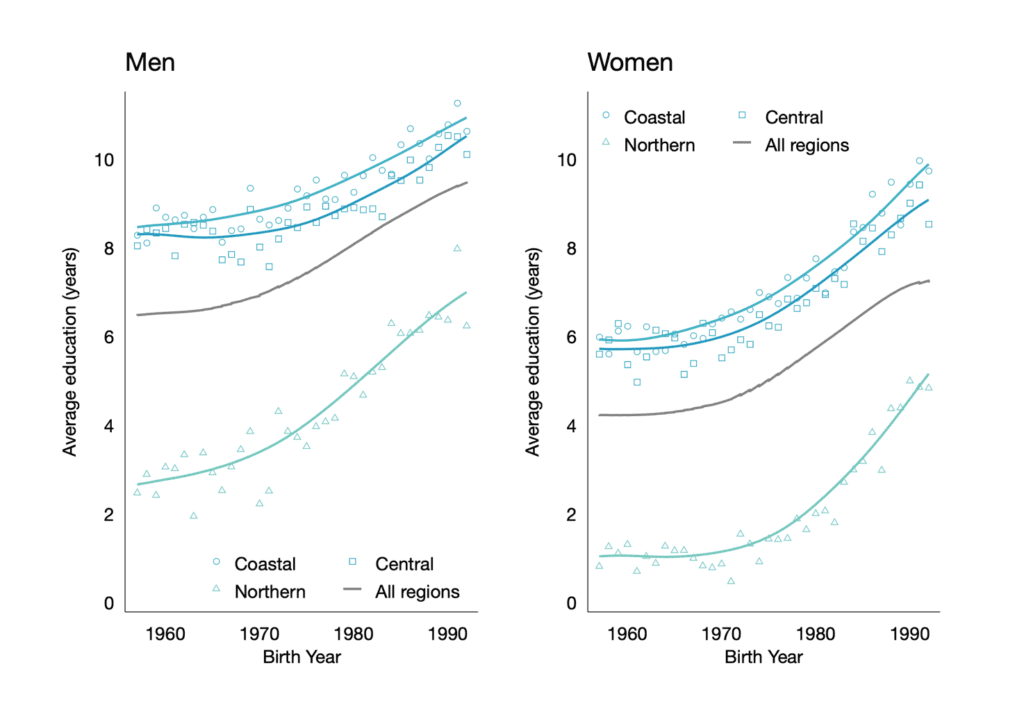
Despite large increases in schooling levels, we find little evidence of increased mobility at the national level, suggesting that universalizing access alone was insufficient to substantially improve the educational position of children from less-educated families. But this masks an important regional story.
Regional mobility gaps narrowed
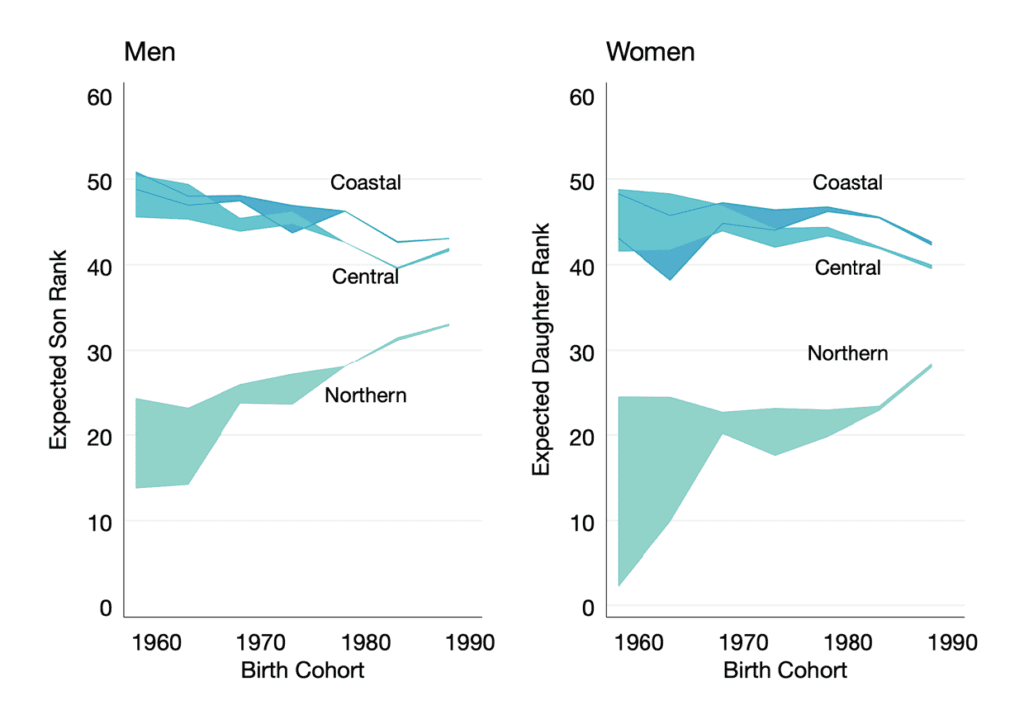
Ghana exhibits a long-standing North-South divide, rooted in colonial and post-independence policies that prioritized infrastructure and education investment in the South. As Figure 2 shows, there has been significant convergence in intergenerational education mobility across regions over time, driven predominantly by improvements in the North.
Sons born in the North in the early 1960s had very limited upward mobility, typically occupying positions below the 20th percentile of the national education distribution. By contrast, those born in the late 1980s reached an expected position around the 33rd percentile of the national education distribution. This means that they achieved higher educational positions than their fathers but remained well below the median.
Meanwhile, mobility declined slightly in the Coastal and Central regions. Overall, the North-South mobility gap narrowed, closing roughly two-thirds of the initial difference.
Figure 2: Mobility of children born to fathers in the bottom half of the education distribution, by region
Did free junior high school increase mobility?
To answer this question, we compare younger cohorts exposed to free junior high school with slightly older cohorts who were not, specifically in districts where the reform had greater potential to change enrolment.
Free junior high school had positive effects on educational attainment. In areas with greater scope for expansion, the policy increased the likelihood that a student would complete junior high school by 15 percentage points, from about 60% to 75%. Gains were even stronger for women and for individuals born in Northern regions (both experienced gains of 19 percentage points).
But did these schooling gains translate into greater mobility? At the national level, the effect on mobility is modest, but there is notable regional variation.
For women born in Northern regions, free junior high school increased their expected educational rank by about 5 percentile points, a meaningful upward shift.
Strong intergenerational persistence despite education expansion
Free junior high school substantially increased schooling but was unable to meaningfully improve equality of opportunity nationwide. This means children of more-educated fathers continue to hold an advantage in the national education distribution. Free junior high school did, however, strengthen upward mobility in the North, narrowing regional disparities. As Ghana’s experience demonstrates, expanding educational access clearly matters, but universal access alone is not enough to equalize opportunity across generations. Although more children are attending school and completing basic education, those from less-educated families still face major barriers in reaching higher positions in the educational distribution. Research suggests that addressing these gaps will require more than access alone: improvements in school quality, pathways to higher levels of education, and broader structural reforms that shape opportunity.
This article is part of a series co-published by GlobalDev and UNU-WIDER that covers research papers accepted to the 2026 WIDER Development Conference on green industrialization and inclusive growth in a fractured world order. It is also available on the UNU-WIDER blog.
(The views expressed in this piece are those of the author(s), and do not necessarily reflect the views of the Institute or the United Nations University, nor the programme/project donors)