At the current extreme poverty line, many lower-middle-income countries already report very low poverty rates. That creates a risk that countries are treated as having largely solved poverty, even when many people still live far from secure or prosperous lives—and very far from standards of living taken for granted in the world’s prosperous countries. Measuring with an upper-bound poverty line changes the picture.
What changes when we use a global poverty line that includes everyone in poverty, including the billions of people who are affected by, but not suffering, the most extreme deprivation? A common measure of global poverty is the World Bank’s international extreme poverty line, currently inflation-adjusted to $3.00 per person per day in 2021 purchasing power parity (2021 PPP). But this is meant to be the lowest plausible global threshold, not a comprehensive measure of poverty.
How should a global upper-bound poverty line be set?
We use two distinct criteria to set a global upper-bound poverty line. The first is the achievement of a decent level of material well-being. Rather than anchoring the poverty line to mere subsistence—as the current extreme poverty line does—we set our upper-bound line at a level of consumption above which a person can reasonably no longer be considered poor. This is commensurate with a standard of living that is only just ‘adequate’ by global standards.
The second criterion is near-enough satiation. In welfare economics, an extra dollar matters far more to someone in poverty than to someone who is already better off. A credible upper-bound poverty line should therefore be set at a consumption level above which an extra dollar actually adds little to well-being.
A new evidence-based poverty line
Estimates in our recent paper show that the empirical evidence points to a global upper-bound poverty line of at least $21.50 (in 2017 PPP) per person per day (sometimes much more). At $21.50 a day, people reach levels at which our measures of material well-being and marginal utility suggest that additional consumption gains begin to matter much less.
$21.50 is also consistent with the national poverty lines of countries that are just marginally considered ‘developed’ countries. Finally, $21.50 is a nice ‘focal point’ at exactly ten times higher than the lower bound (the World Bank’s extreme poverty line) of $2.15 (2017 PPP) or $3 (2021 PPP).
The empirical work also shows that the World Bank’s current highest poverty line of $6.85 (2017 PPP) per person per day, the average national poverty line of upper-middle-income countries, falls short of what is needed to serve as a credible global upper bound. At $6.85, people are neither achieving high levels of material well-being nor are further gains minimally important to well-being—every little bit still counts a lot. (The new June 2025 poverty lines are just inflation updates and so reflect the same level of consumption in real terms.)
Far more people are in a condition of global poverty than is implied by the low-bar standard for extreme poverty. Figure 1 shows poverty headcount rates in various countries, counted at both the lower-bound poverty line and the upper-bound $21.50 poverty line, as well as the Prosperity Gap, which is the World Bank’s new measure of shared prosperity.
In Denmark, a very high-income country, almost nobody is poor at either line (0.1% and 2.8%), while in Malawi, 70.5% are in lower-bound poverty and 99.9% are in upper-bound poverty. But these are the extremes. In many countries, these two standards imply either that almost no one is poor or that nearly everyone is poor. This is the case in Pakistan, at 4.8% in extreme poverty, but 99.5% still below the upper bound. Similarly, in Indonesia, only 2.8% of people are in extreme poverty, while 97.5% fall under the global upper-bound poverty line.
These striking gaps between extreme and global upper-bound poverty rates reflect the very large differences in standards of living between the rich countries and the rest of the world. A household at the 10th percentile of the income distribution in Denmark lives on nearly three times as much as an Indonesian household at the 90th percentile in Indonesia.
These enormous cross-national inequalities imply that, in poor countries, nearly everyone has a material standard of living lower than what is, in our assessment, a reasonable global standard for poverty, which is still well below the poverty lines of the richest countries.
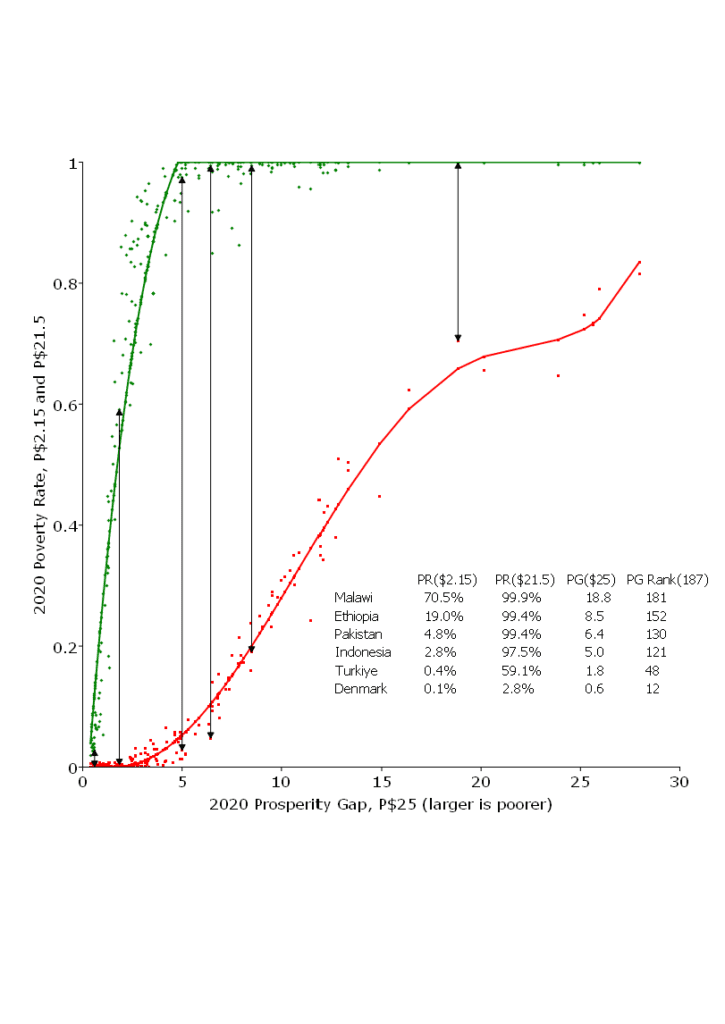
Note: Y-axis is the share of the population in poverty at either of the two poverty lines.
Why this matters
Adopting a global upper-bound poverty line alongside the global lower-bound lines and national poverty lines offers a more complete picture of development progress and challenges, and changes the way we think about development success.
The predominant focus on a ‘dollar-a-day’ poverty line has tended to orient development economics toward targeted redistributive programmes. One consequence is that broader opportunities for productivity-led income growth may receive less attention, particularly where their benefits are not concentrated among those below the extreme poverty line. Similarly, an exclusive focus on extreme poverty may lead to underestimates of the scale of energy needs associated with raising living standards in lower-income countries.
When assessed against the extreme poverty line alone, a number of countries appear to have largely addressed income poverty, even as many of their citizens continue to face material deprivation, economic insecurity, and little resilience to withstand shocks. This risks reducing the perceived urgency of development assistance to countries still facing enormous development challenges.
A heavy reliance on the global lower-bound risks suggesting that income gains beyond the extreme poverty threshold are of secondary concern to development policy, leaving a large share of the population outside the frame of measurement. At $21.50, the focus shifts to the larger and much more inclusive challenge of achieving shared prosperity for people around the world, across all income levels and regions.
A global upper-bound poverty line of $21.50 (2017 PPP) per person per day, used alongside existing poverty lines, would provide a more inclusive and policy-relevant picture of global poverty. It would also bring the officially reported measures of poverty closer to the ambitions of the Sustainable Development Goals to “end poverty in all its forms, everywhere”.
This article is part of a series co-published by GlobalDev and UNU-WIDER that covers research papers accepted to the 2026 WIDER Development Conference on green industrialization and inclusive growth in a fractured world order. It is also available on the UNU-WIDER blog.
(The views expressed in this piece are those of the author(s), and do not necessarily reflect the views of the Institute or the United Nations University, nor the programme/project donors)