Floods across South Asia are becoming increasingly predictable, yet they continue to trigger large-scale humanitarian crises and reverse years of development progress. Advances in forecasting systems, satellite monitoring, and hydrological modelling now allow governments to anticipate many flood events, days in advance. However, early warnings rarely translate into early action. As climate change intensifies monsoon variability and extreme rainfall across the region, the challenge is no longer simply forecasting floods but building governance systems that protect vulnerable communities before disaster strikes.
Floods account for roughly 35–40% of all global weather-related disasters, and their frequency is rising rapidly. Since 2000, the number of recorded floods has increased sharply, up by 134% compared with the previous two decades. South Asia sits at the epicenter of that risk. The catastrophic floods in Pakistan in 2022 alone affected more than 30 million people, and every year, seasonal floods displace millions more across the region.
Yet in many cases these disasters are not sudden shocks. With modern forecasting systems, river gauges, and satellite monitoring, floods in the region can often be predicted days in advance. The real problem is not a lack of warning – it is a lack of action. As South Asia approaches another monsoon season, the region faces a critical policy question: why do predictable floods still become humanitarian crises?
A lack of scientific capacity is not the issue. Over the past two decades, governments across South Asia have invested heavily in forecasting systems and early warning networks. Bangladesh runs advanced hydrological models and shares upstream river data. India’s Central Water Commission operates hundreds of flood forecasting stations. Nepal and Bhutan have expanded early warning networks along major river basins. In other words, the necessary science and technology is there. What remains uneven is the ability to translate those forecasts into timely decisions and financing before disaster strikes.
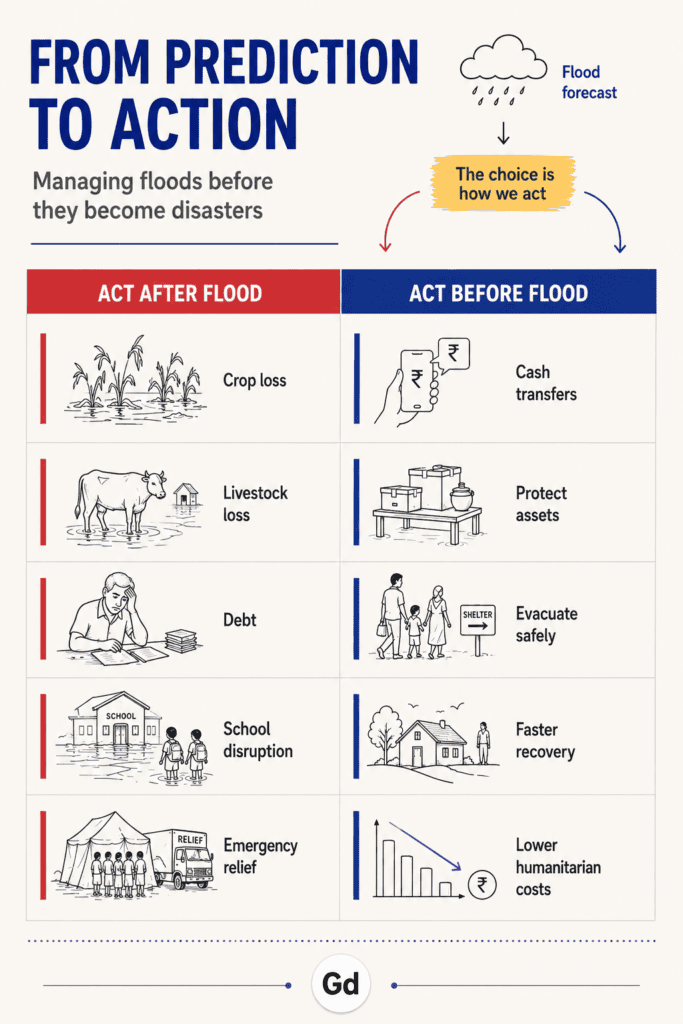
Bangladesh, however, is beginning to demonstrate what this shift can look like. Anticipatory cash transfers and livestock protection measures have helped households protect assets and reduce recovery time after floods. Studies from forecast-based financing pilots have shown that acting early can significantly reduce humanitarian costs while preventing families from falling deeper into poverty.
While challenges remain, its experience offers an important lesson for the rest of the region: accurate forecasts save lives only when they are linked to institutions, financing, and clear protocols that allow governments to act before disasters unfold.
Around the world, governments and humanitarian agencies are increasingly testing forecast-based financing and anticipatory action. Forecast-based financing pilots in Uganda and during El Niño flood risks in Peru have supported evacuations, strengthened homes, protected livestock, and prepared communities before disasters occurred. According to the World Food Programme, the Philippines is also integrating anticipatory action into its national disaster management and social protection systems, while Mozambique has embedded anticipatory action into national contingency planning for floods, droughts and cyclones.
These experiences demonstrate that anticipatory action is both feasible and effective across very different contexts. The question is no longer whether governments can act before disasters strike, but why this approach has yet to become the norm despite increasingly reliable forecasts. The costs of failing to act early extend far beyond the immediate destruction caused by floods.
The costs of delayed action
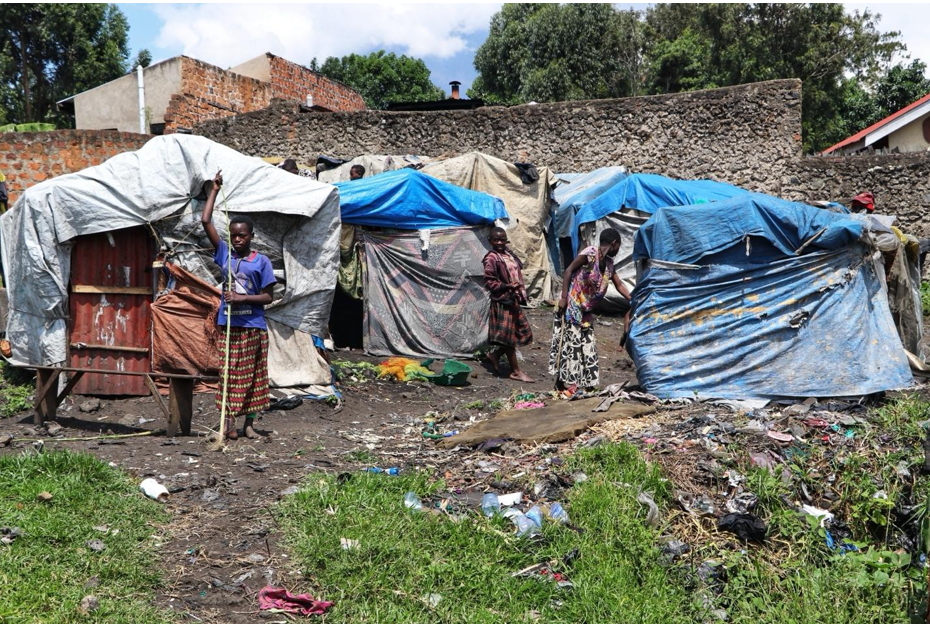
Floods can erase years of development progress in a matter of days. Across South Asia, repeated flooding pushes vulnerable households deeper into poverty, disrupts children’s education, damages public health systems, and weakens long-term livelihood security. For low-income families dependent on agriculture, fisheries, or informal labor, the loss of crops, livestock, housing, or income often triggers debt accumulation, distress migration, and the sale of productive assets needed for future recovery.
The economic costs of floods also rise sharply when governments act only after disasters occur. In many countries, emergency financing is released only after formal disaster declarations, administrative approvals, and political negotiations, delaying assistance until livelihoods have already collapsed. By then, households may already have withdrawn children from school, reduced food consumption, taken high-interest informal loans, or migrated in search of work.
Evidence increasingly suggests that acting before disasters occur is not only more humane but also more cost-effective. The World Bank estimates that strengthening social protection systems, early warning access, financial inclusion, and anticipatory response mechanisms could generate global well-being gains equivalent to roughly $100 billion per year. In this sense, anticipatory action is a long-term development and fiscal strategy – especially in the context of a funding crisis.
Policy implications
The experiences emerging across South Asia and elsewhere point towards three priorities for governments seeking to move from reactive disaster response to anticipatory flood management.
First, institutionalize anticipatory financing systems. Forecasts must be linked to pre-agreed operational decisions rather than serving only as warnings. Governments should establish trigger-based financing mechanisms that automatically release resources when flood forecasts reach agreed thresholds. For example, if river levels exceed predefined limits, shelters should open automatically, emergency transport should be mobilized, and emergency funding should be released before disaster strikes. Expanding digital public infrastructure (DPI), including mobile banking and digital identity systems, also creates new opportunities to deliver targeted cash transfers to vulnerable households before floodwater arrives.
Second, strengthen climate-responsive social protection and local preparedness. Disaster response too often begins only after damage has already occurred, by which time livelihoods have been disrupted and development gains reversed. Governments should maintain updated lists of vulnerable households, conduct regular evacuation drills, ensure that schools and community centers function as safe shelters, and design social protection systems that can temporarily expand during climate shocks. Early cash or food assistance triggered by flood forecasts can help families protect assets, avoid distress borrowing, and recover more quickly.
Finally, treat flood resilience as a regional public good. South Asia’s major rivers, including the Ganges, Brahmaputra and Meghna, cross national borders before reaching the sea, meaning that upstream decisions often determine downstream flooding. Despite this reality, cross-border coordination on flood management remains limited and politically sensitive. Real-time data sharing, joint flood bulletins for border regions, and coordinated dam management could significantly reduce downstream impacts.
The time for action is now
Each year, policy discussions intensify only after floodwaters have already displaced communities and destroyed livelihoods. Yet the most effective solutions are those implemented months before the rain arrives.
South Asia has many of the ingredients required to lead the world in anticipatory climate resilience: strong scientific institutions, expanding digital infrastructure, and decades of experience in disaster management. What remains is the political will to connect these pieces into a system that acts on forecasts rather than headlines. The monsoon may always bring rain, but predictable floods should no longer lead to predictable suffering.